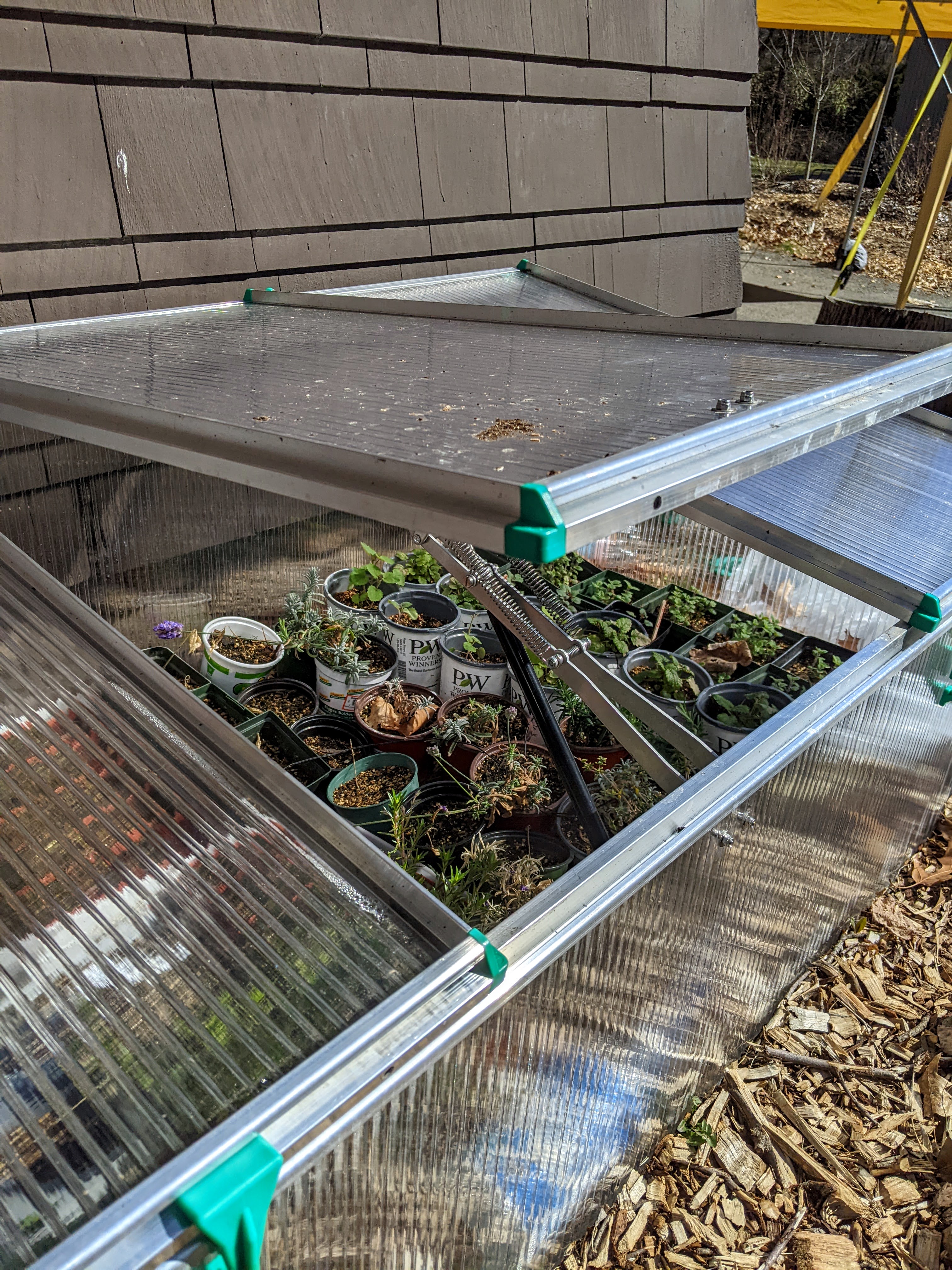
You’ve heard of greenhouses, grow lights, and low tunnels, but have you ever considered cold frames?
In this episode of The Farmer in the Red Hat, farmer Joe will educate, inspire, and perhaps even thrill you with a really cool little invention called a cold frame!
In the northeast, farmers and gardeners often try to trick mother nature into giving us a longer growing season. Gardeners resort to a wide variety of methods; some simple and some elaborate. We build greenhouses, caterpillar tunnels, hoop houses, low tunnels, row covers, cloches, and cold frames.
Our journey to trick mother nature has been a slow, gradual one. For many years, we have sowed and grew our seedlings under grow lights in the warmth of our living room. We gradually upgraded to heat mats and a larger set up in our basement, where rows of seedlings would not be disturbed by our curious toddlers or mischievous hounds. In the last few years we have been starting to use fleece row covers to protect plants in the garden so we can plant them out a few weeks earlier than normal and protect them from the cold. This year we added another tool to our tool box, the cold frame.
What is a cold frame?
Without trying to produce a textbook definition, a cold frame is any small, insulated structure that is glazed; allowing the sun’s rays to heat the inside and provide light for the plants. An important feature of the cold frame is that it is not actively heated. The goal is to keep the plants from getting too cold during the off season to avoid damage. This is not a method for tropical plants to thrive; it needs to be used appropriately with the right plants at the right time
Our Cold Frame; buying vs building:
While we are reasonably handy and could build a cold frame from scrap lumber, straw bales, and an old window or a piece of polycarbonate laid on top for glazing, we went with a purchased option. Balancing the long term durability of what we could build vs what we could buy, and the many other demands on our time, this was the right decision. Building vs buying will always be a decision you have to make in homesteading, and it’s important to do those things where you alone can add value, and realize that there is a trade off when choosing to engage in one project means you’ll have to forgo another one.
Our cold frame uses 8mm UV stabilized twinwall polycarbonate for glazing (with an advertised 10 year life), and aluminum and plastic parts to hold it together, which won’t rust or corrode. The twinwall polycarbonate acts as both insulation and glazing, allowing the sun in, while providing a gap, like a double glazed window, to keep in as much heat in as possible. This frame from Juwell, called the Biostar 1500 (https://www.exaco.com/biostar1500-coldframe.php), gives us just over 13 sq ft of growing space. With an included automatic vent opener (more on that below), this was a pretty good deal compared to the other ‘bargain’ cold frames out there on the market. The three panels across the top can all be propped open for ventilation to ensure the plants don’t overheat on very sunny days.
How to use your cold frame:
Your cold frame should be positioned where it gets the most sun, but you also need to consider protection from the elements, like wind. Keep in mind that unless you are putting it directly on your garden to protect plants that are in there, it doesn’t have to be in your garden. We have ours up against the south side of the house where I can keep an eye on it and manage it more directly without much effort. If you are in the northern hemisphere, make sure your glazing faces south to capture as much of the sun’s rays as possible.
Cold frames are not just a set it and forget it project. Like all tools or techniques you utilize to grow food there is some sort of management involved. If it gets too cold out at night, your cold frame might need an extra layer of protection, like an old blanket, to insulate the plants. If the day gets too warm and the sun gets too intense, you need to open and vent the frame so the plants don’t cook. A quick, daily check of the weather forecast and a few minutes of time either opening or closing the frame is all it takes to keep your plants healthy. Remember to water your plants! This may seem obvious but because they are “outside,” you might forget! If it’s very sunny out, your plants will be getting warmer and using more water. If it stays cool and cloudy they will likely need watering less often.
This is where an automatic vent opener comes in handy. If I’m too late getting out to open the frame when it’s sunny, or I forget to close the frame at night, the vent opener is an electricity free mechanism that opens and closes one of the top panels in response to the temperature inside the frame via a piston and wax cylinder.

During the winter we use our cold frame to keep alive a few plants that, while hardy to our climate, have a tendency to succumb to root rot if kept in pots on our deck buried in snow with water logged soil. One example is our culinary sage. They won’t put on new growth and thrive, but they will live and get a fast jump come spring.
In the late winter through early spring, we parade a variety of plants through the cold frame. Remember that the cold frame is simply warmer by a few degrees than the weather outside, not a highly controlled climate like the inside of your house. This means DO NOT put tomatoes in your cold frame when it’s still 20 degrees F outside when the tomatoes need it to be quite a bit hotter than that. As seedlings are started inside in our growing station, they are slowly transitioned outside to the cold frame to make room for the next set of seeds to take their place. This allows the maturing plants some time to adapt to the sun before they are planted out in the garden, while it might still be just a little bit too cold to do so just yet.

For everything, there is a season:
During the summer we have no use for the cold frame as there are no plants that need protecting from the cold. This is when we can take advantage of the light weight of this frame at around 20 pounds. Rather than leave the polycarbonate in the summer sun, with more UV than the winter sun, to degrade more of its 10 year useful life, we can store the frame in our garage out of the elements, allowing it to last many many years longer and keep providing benefits.
Do you have a cold frame in your garden? How do you use it? How did you construct yours? Post below in the comments, we would love to hear your ideas, thoughts, successes and questions!
Leave a Reply